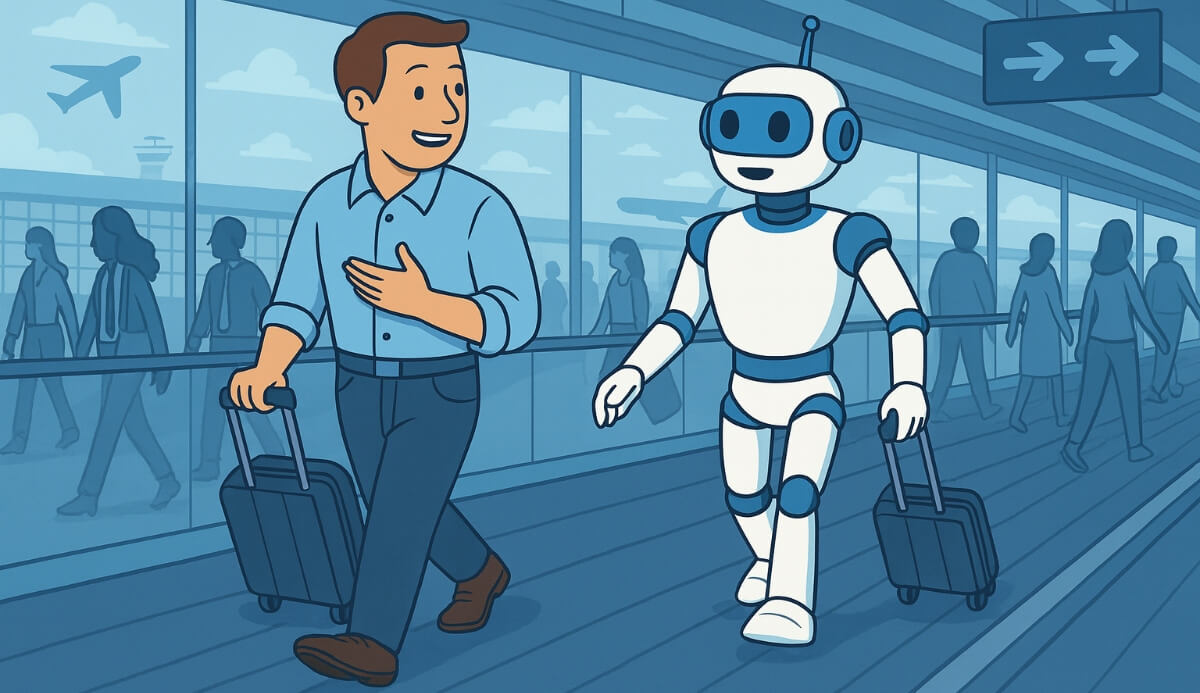
I stepped onto the moving walkway at Charlotte Douglas International Airport, suitcase rolling behind me, and kept walking at my normal pace. Within seconds, I was gliding past travelers on the regular floor, covering twice the distance without breaking a sweat or stumbling over my luggage.
That's when it clicked.
This is exactly what AI feels like.
I was heading home from my latest round of AI workshops, brain still buzzing from a week of conversations about how teams can move from experimenting with AI to actually implementing it. How do you go from "playing around" with ChatGPT or Claude to using them every day in structured, repeatable ways that genuinely make you work smarter?
The answer was moving beneath my feet.
What the walkway taught me about AI
Standing still on the moving walkway doesn't get you far, not quickly, anyway. You might move forward, but barely any faster than the people walking beside it. It's comfortable, but it's not efficient.
The magic happens when you walk with intention. You're putting in effort, focus, and direction, but suddenly you're covering ground at nearly double the pace. Same energy input, dramatically better output.
And if you try to sprint on it without control? That's when people trip over their suitcases.
AI works the same way. If you let it do everything for you, you won't progress much. If you move with it, guiding and shaping its output with your own experience, you go farther, faster. And if you rush in without intention or guardrails, you risk confusion and burnout.
AI turns motion into momentum.
From playing around to practical use
That's been the biggest takeaway from the AI workshops I've led recently with editorial and advertising teams.
Most people start in the same place: experimentation. They open ChatGPT or Claude, ask it a few fun prompts, and are amazed by what comes back. But the next question is always the same—now what? How do I actually use this in my day-to-day work?
The shift happens when they stop treating AI as a novelty and start seeing it as infrastructure.
Here's what that can look like in practice:
- Writers can research topics, create article outlines from notes and sources, and get instant feedback on their clarity, tone, and SEO elements in realtime.
- Reporters can use AI to transcribe and analyze interviews and meetings, surfacing insights and quotes in seconds rather than rewinding recordings for hours.
- Sales teams can conduct deep background research on a potential client and draft proposal outlines in minutes instead of days.
- Editors can create content briefs and review articles for brand and style guide compliance in minutes, spending that saved time coaching writers instead.
- You can prepare a slide deck from rough notes in minutes, freeing up more time to refine your message and rehearse your delivery instead of fighting with formatting.
That's when experimentation becomes implementation. That's when the walkway starts moving.
One participant emailed me after a recent workshop to say the live AI demonstrations were "jaw dropping." But what's more astonishing than what AI can do alone is what we can accomplish with AI as our co-pilot.
The goal isn't to let AI write or think for you. The goal is to walk alongside it.
How AI has accelerated my own work
I've seen this transformation personally since launching my business with AI in August.
Working with ChatGPT and Claude has helped me think faster and deeper. I can validate ideas before investing days into them. I can move from concept to execution in hours instead of weeks.
I can explore adjacent skills and industries I never would have touched before.
The clearest example: I'm currently building a custom AI tool for a client using a no-code platform. Three months ago, I'd never used this type of platform. I had no idea you could design conversational flows, train AI agents with custom knowledge, or deploy something genuinely useful without writing code.
I'm an English major with 12 years of content leadership experience. My "technical background" is HTML and troubleshooting WordPress. And yet, with support from ChatGPT and Claude, I've gone from discovery to deployment in a matter of months—building something I never thought I'd be capable of creating.
Could I have learned this on my own eventually? Maybe. But it would have taken months of false starts, frustration, and abandoned attempts. With AI as my co-pilot, I've compressed that learning curve dramatically.
I'm not standing still on the walkway, waiting for AI to carry me. I'm walking, asking questions, testing ideas, troubleshooting errors, refining prompts. But AI is accelerating every step of that process.
The right balance: human motion + machine acceleration
The balance I talk about most often with teams is the combination of human intention and machine acceleration.
AI won't create your goals, your direction, or your ideas. It won't know what matters to your audience or what your brand voice should sound like. It won't catch the nuances that make a story compelling or know when to push back on a client's unrealistic request.
But once you have those things, once you know where you're going, AI can make the process faster, more organized, and surprisingly more creative.
The people and teams getting the most value from AI aren't the ones standing still, hoping it will carry them to success. They're the ones walking with purpose, using AI to move a little faster each day toward goals that already matter to them.
Keep looking forward
Like a moving walkway, AI has limits. It can't take you everywhere. There are guardrails, and eventually, there's an endpoint where you have to step off and navigate on your own.
You still have to know where you're going. You still have to keep your balance. You still have to watch for what's ahead so you know when the walkway ends and when it's time to transition back to your own two feet.
But when you use it with intention—when you step on, start walking, and stay focused on your destination—it can get you where you want to go faster, with less friction, and maybe even with a little more confidence in your stride.
Because the real power of AI isn't in what it replaces.
It's in how it helps us keep moving forward.
Ready to accelerate your team's work with AI? Whether you're just starting to experiment or ready to move from playing around to practical implementation, I'd love to help. Learn more about my workshops and services.