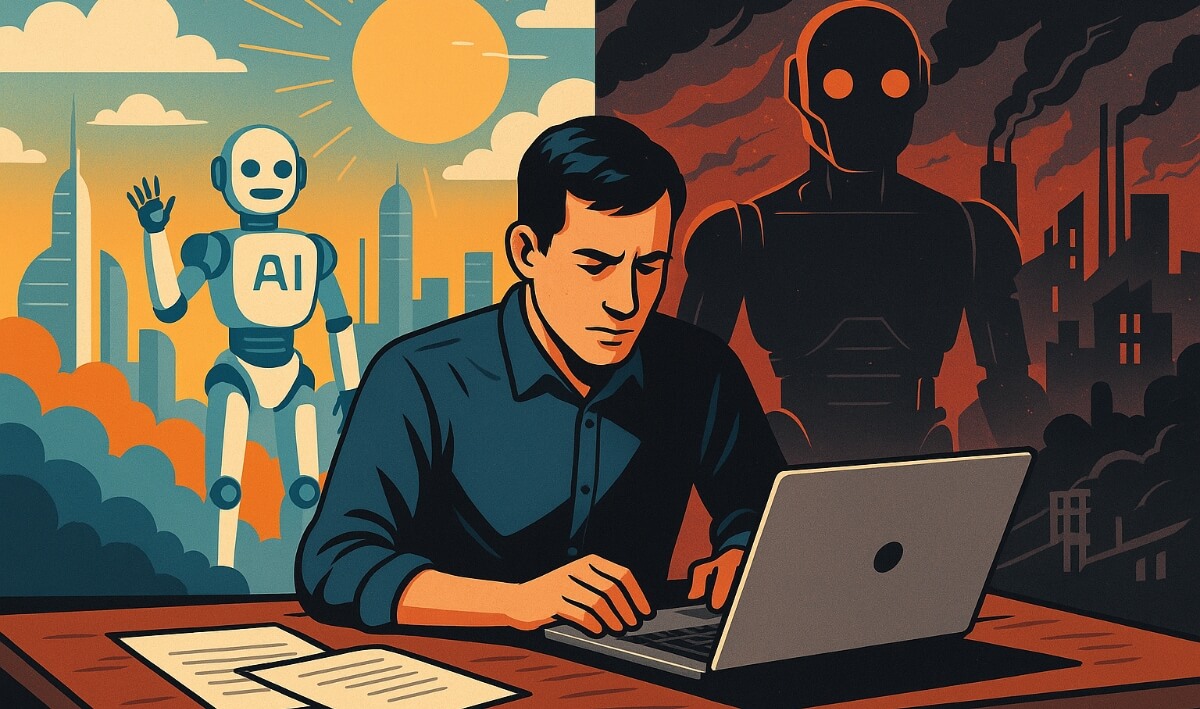
Reflections on David Wallace-Wells' take on AI's cultural shift.
Why this article stood out
AI coverage often swings between extremes: utopian visions of machines saving the world, or dystopian fears of AI replacing us entirely. That's why David Wallace-Wells' recent New York Times column, "A.I. May Be Just Kind of Ordinary" caught my eye. Instead of playing to the hype, he suggests something simpler, and maybe more powerful: AI is starting to feel normal.
The cultural shift
Wallace-Wells charts how our cultural vibes around AI have evolved since ChatGPT exploded in late 2022. In just a few years, AI has moved from mystic hype and techno-prophecy into everyday utility. Like electricity or the internet, its revolutionary power is undeniable. And just like those two technologies, it's also quietly becoming a "normal" part of daily life.
Key stats he highlights
- More than half of Americans have used AI tools.
- One-third of Americans use AI every day.
- Up to 60% of recent stock market growth has come from AI-tied companies.
That's a staggering adoption curve for such a short timeline.
My favorite line
"As A.I. has begun to settle like sediment into the corners of our lives, A.I. hype has evolved, too, passing out of its prophetic phase into something more quotidian..."
This captures something I see daily in my own work: AI isn't just a shiny experiment anymore. It's becoming a tool professionals use to get things done, faster, smarter, more consistently. I also love the sediment simile and how it expresses the way AI is suddenly everywhere.
Why this matters for business leaders
As a content strategist, I see many teams struggling with this exact transition. They've moved past curiosity and now need practical workflows:
- How do we integrate AI into content creation without losing brand voice?
- Where can AI improve efficiency without sacrificing quality?
- How do we build processes so AI complements people, rather than replaces them?
That's the "ordinary" phase Wallace-Wells points to, and it's where there is real business value in these technologies.
Final thought
The real story isn't whether AI will save or doom us. It's how quickly it's settling into the everyday fabric of work and life. Learning how to make AI capabilities an "ordinary" part of our workflows is how we can make it truly transformative.