I spent three weeks building something I never thought possible.
An AI application. A real one. The kind with buttons and logic and an actual interface. The kind that solves a real problem for a real team.
And here's the part that still surprises me: I did it without writing a single line of code.
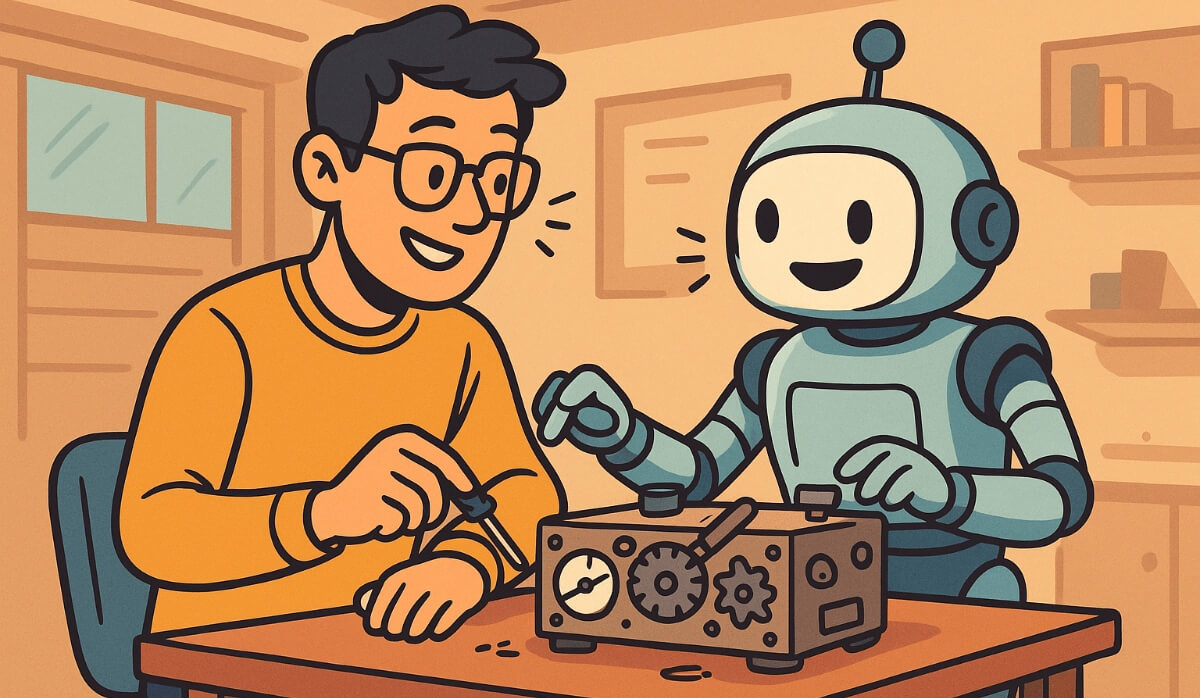
Instead, I built it with AI as my co-creator. It wasn't just a tool I used, but an actual partner that helped me brainstorm, debug problems, and iterate as I figured things out in real time.
It was one of the most exciting and energizing projects I've worked on this year. And it changed how I think about what's possible.
The Real Problem That Sparked the Project
I didn't set out to build an AI app, I still assumed that was beyond my capabilities. I was simply trying to help a client solve a very human challenge.
A client needed a better way to train and coach their teams. They needed something more consistent, accessible, and scalable than traditional one-off training sessions. They wanted their people to run through challenging conversations, adapt to tough questions, and get real-time coaching feedback, anytime they needed it.
After delivering my first AI workshops, I started wondering: What if AI could simulate those conversations? What if it could practice with you instead of just giving you tips? What if it could coach you afterward? And what if all of this could be customized to the specifics of their workflow, industry, and location?
Those questions led me to one answer, then another, and another, until I felt confident proposing that I could build them a custom AI tool.
To protect client confidentiality, I'm keeping the details general here, but the challenges are ones many teams will recognize.
Breaking the Myth: You Don't Need to Code to Build AI Tools
I'd heard of no-code and low-code platforms before, but I assumed they still required more technical know-how than I possessed. As I've mentioned, I'm not a software engineer or developer. I was an English major.
The extent of my coding knowledge begins and ends with <p> tags in HTML.
But here's what I learned over the last three weeks:
You don't need to be a coder to build with AI. You just need to understand the workflow you're trying to improve. Defining the problem and brainstorming solutions is the essential part. The technical stuff? Completely solvable.
I don't believe AI is replacing the need for developers. There are still plenty of advanced cases where technical expertise is necessary. But I do believe AI is massively lowering the barrier for non-technical people to build meaningful, effective tools. It's democratizing capabilities and giving all of us more options.
And that shift changes everything.
How I Built It: Co-Creating With AI Step-by-Step
For three weeks, I basically lived in conversation with Claude, the generative AI assistant from Anthropic, and ChatGPT from OpenAI.
I'd start each day with a quick recap and update, almost like a morning standup meeting: "Okay, here's what we accomplished yesterday, and here's what we need to fix today. How do we do it?" And I'd end each night with more features working and more steps in the flow built out.
It wasn't just me using AI. It was me and AI building together.
Here's what that looked like in practice.
I defined the idea, AI helped shape the structure.
I knew who the tool was for, what they needed to practice, how the conversation should flow, and why the training mattered. AI helped me turn all of that into a branching logic map, user intake flows, decision points, and variable structures.
I knew where we needed to go. AI knew how to get there. It took my idea and sense of "I think this could work" and turned it into "Here's exactly how to build it."
I explained what the tool needed to do, AI helped me build it.
To develop and train the AI agents at the heart of the tool, I described the types of scenarios and personas the tool needed to include. I also provided lots of context and examples. Claude took this and structured the data the way I needed it, asked follow-up questions, and requested additional resources to help fill in any gaps.
We gradually built out a complete set of AI instructions for multiple agents within the system. Our instructions defined each one's role, provided positive and negative examples, set specific exit conditions, and gave them access to a complete knowledge base of industry and location-specific data.
We shaped conversations across three difficulty levels, including easy, moderate, and challenging, with personality variations and realistic follow-up questions for each.
AI gave me options. I gave it direction. Together we built something that actually worked.
I built the logic, AI helped me debug it.
This part was unexpectedly fun.
Before I knew it, I was setting variables, building logic flows, and defining chunk limits and temperature settings. Even when things got really technical, like trying to spot a missing brace in a line of JSON code, I simply copy/pasted the code snippet into my conversation with Claude or ChatGPT and the AI found it.
For every roadblock I ran into, AI diagnosed it, explained why it broke, and helped me fix it.
Every bug was a lesson. Every solution made me better. You know that moment when you finally solve something and see it working like you planned? This project was three straight weeks of that.
The tool got smarter as I got smarter.
As I improved the structure, context, and instructions, my new AI tool improved its responses. As I cleaned up the scenarios, the coaching got sharper. As I learned the workflow more deeply, the app became more aligned with what the team actually needed.
It wasn't me teaching AI. It was me learning alongside AI.
That was the unexpected magic.
5 Lessons From Building My First AI Application
Building this tool taught me so much, both technically and strategically. Here are my biggest takeaways.
AI accelerates execution, not imagination.
Here's what AI couldn't do: it couldn't tell me what to build. It had no idea what mattered to this team. It didn't know that practice scenarios needed to feel realistic or that feedback needed to be constructive without being discouraging. I had to bring all of the human context and detail.
But once I did? AI helped me build it into a real, working tool in less time than I could have imagined.
AI won't come up with your idea. It doesn't know what problems you need to solve. But once you can explain what you're trying to accomplish, AI can help you build it very, very fast.
No-code tools are far more powerful than people think.
I used four tools to build this: Voiceflow, Make, OpenAI's API, and Google Sheets.
These were more than enough to create an interactive training system with multi-agent logic, realistic simulations, automated coaching, session logging, conversation transcripts, and performance tracking.
All without writing any code.
There are now more AI tools available to more people than ever before. And you can learn as you build with AI assistants like Claude and ChatGPT. You don't need to know all the technical details before you get started. You just need to know where you want to go so you can continually steer the project towards success.
Creating advanced digital solutions is now possible for anyone, not just developers.
Context is everything.
Generic AI gives generic answers. Specific AI gives value.
Once I added business context, real objections, actual terminology, workflow details, and personality traits, the tool stopped sounding like "AI" and started sounding like a real person.
That's the difference between a demo and something your team actually wants to use.
You don't necessarily need to build the next big thing for everybody. You just need to build the next big thing customized for your team or your clients.
Iteration beats perfection, especially with AI.
I didn't start with "the final version." I started with something small, messy, and workable.
Then, I worked alongside my AI assistants to test, tweak, and refine it, step by step.
Every iteration made the tool better. And AI helped me iterate and grow the tool quickly.
The future isn't AI replacing people, it's AI multiplying them.
The tool I built doesn't replace human one-on-one training. It supplements and reinforces it. It gives people a way to practice, explore, and build confidence on their own schedule.
AI isn't here to do your job. It's here to help make you incredibly good at your job.
Once you see that shift, everything changes.
Why This Matters for Your Business Right Now
I'm more convinced than ever that we're entering a moment where small teams and individuals can build big things.
Not because AI does everything for you, but because AI makes building accessible.
You don't need to hire an agency to build a custom tool. You don't need a full engineering team. You don't need a six-figure budget. You don't need to wait six months to ship something. What you do need is insight into your workflow, clarity about the problem, and someone who can bridge business needs with AI capabilities.
The opportunities are everywhere: training systems, customer research tools, onboarding flows, content workflows, pitch prep, proposal generation, brainstorming frameworks, internal communication, data organization, feedback loops.
Every team and every process has friction somewhere. AI tools can help you reduce that friction in days or weeks instead of months or years.
What's Next for This Tool (And What I Learned About Building)
The tool is live. And the client is already asking what else we can build.
There's definitely room to grow: better analytics, more dynamic scenario logic, expanded coaching paths, onboarding flows, maybe even versions for other departments.
Even at this stage, it's already one of the most meaningful projects I've taken on in my career. Not because it's flashy or world-changing, but because I built something useful for my client and learned new skills while doing it.
And because it reminded me of something important: We're not just passively using AI tools to automate every task. We're learning how to actively build with them.
That's where the real potential of this moment lives.
Ready to Build a Custom AI Solution for Your Team?
If this sparked an idea for your team, even a small one, I'd love to help you explore it.
You don't need to know how to code. You don't need a perfect vision. You don't need a full roadmap. You just need a workflow that feels heavier than it should, a training gap that needs filling, or a process that could be better.
Because if there's anything this project taught me, it's that with the right approach, almost any team can build something powerful with AI. And you can build it faster than you think.
This is a fun time to build. Let's see what's possible.