One year ago today, I lost my job.
At the time, it didn't feel like the end of a chapter. It felt like the ground had disappeared beneath me.
I've already written about what happened that day and how I launched this business. If you've read that post, you know the basics: sudden layoff, months of struggle, one pivotal conversation with ChatGPT that helped me see a path forward.
But where that post ends is where the real story begins.
This isn't about the day everything changed. It's about the year that followed, and what I've learned about rebuilding when the ground shifts beneath you.
What I didn't know a year ago
Last December, I'd never used ChatGPT. I knew almost nothing about AI beyond the hype and the fear. I certainly didn't know it would become central to how I work.
Many of the conversations I had during that time included the same question: "What experience do you have with AI?"
At the time, the honest answer was: not much.
That question kept coming up, and eventually I realized it wasn't going away. If I wanted a future in content, or anywhere, I needed to understand this shift rather than avoid it.
So I started learning.
Initially, I thought "learning AI" meant taking online courses and getting certifications so I could talk about it in interviews and list it on resumes. But the more I used it, the more I sensed a fundamental change taking place.
What mattered wasn't learning about AI. It was learning how much I could unlock with AI.
Over the past year, I went from writing prompts to designing workflows to (somehow) building a fully custom AI training application for a client. Not a demo. Not a proof of concept. An actual tool that a real team uses in production every day.
I'm still an English major. I still don't code. But I built something I didn't think was possible.
And I'm still discovering new possibilities every day.
The real transformation
In August, I launched Noel Content Solutions thinking I'd do what I've always done: write articles, edit content, build strategies, maybe coach some teams.
That's not what happened.
What started as a small freelance practice quickly became something larger and more energizing than I expected.
Within a few months, I was:
- Leading in-person AI workshops for editorial and advertising teams
- Building custom AI workflows that save clients hours every week
- Designing and shipping a multi-agent AI training system using no-code platforms
- Helping organizations navigate AI adoption without the overwhelm
None of that was in the plan.
The biggest surprise? I love doing this and I'm pretty good at it. Not because I suddenly became a technical wizard, but because I'd already spent 12 years learning how content teams actually work. I understand workflows. I know where friction lives. I can translate what tools are available and where they can plug in for teams struggling with messy or outdated processes.
AI didn't replace my skills. It gave me new ways to apply them.
What building with AI taught me that prompting never could
I wrote recently about building my first AI tool, and I tried to capture what that process felt like. But there's something I didn't say clearly enough:
Using AI and building with AI are completely different experiences.
When you use AI, you're asking it to do things for you.
When you build with AI, you're enhancing your own skills to create and solve alongside it.
That shift, from consumer to creator, changed how I see my own capabilities.
Last year, if someone had asked me to build a custom training system with AI agents, real-time coaching, and performance tracking, I would have said: "You need a developer."
This year, I built exactly that. In three weeks. Without writing code. Not because AI did it for me, but because AI made it possible for me to learn and upskill in real time.
For anyone experiencing their own hard year
If you're in the middle of a layoff, a career pivot, or just a season where nothing feels certain, I want to say something I wish I'd heard more clearly a year ago:
You're not behind and you're not obsolete.
I know it feels that way. I know AI seems like it's moving faster than you can keep up. I know the job market feels impossible. I know it's hard to feel confident when everything around you is shifting.
But here's what I've learned:
Your experience still matters. The skills you spent years building still matter. You still matter.
You don't need to become a different person. You need to find new ways to apply what you already know.
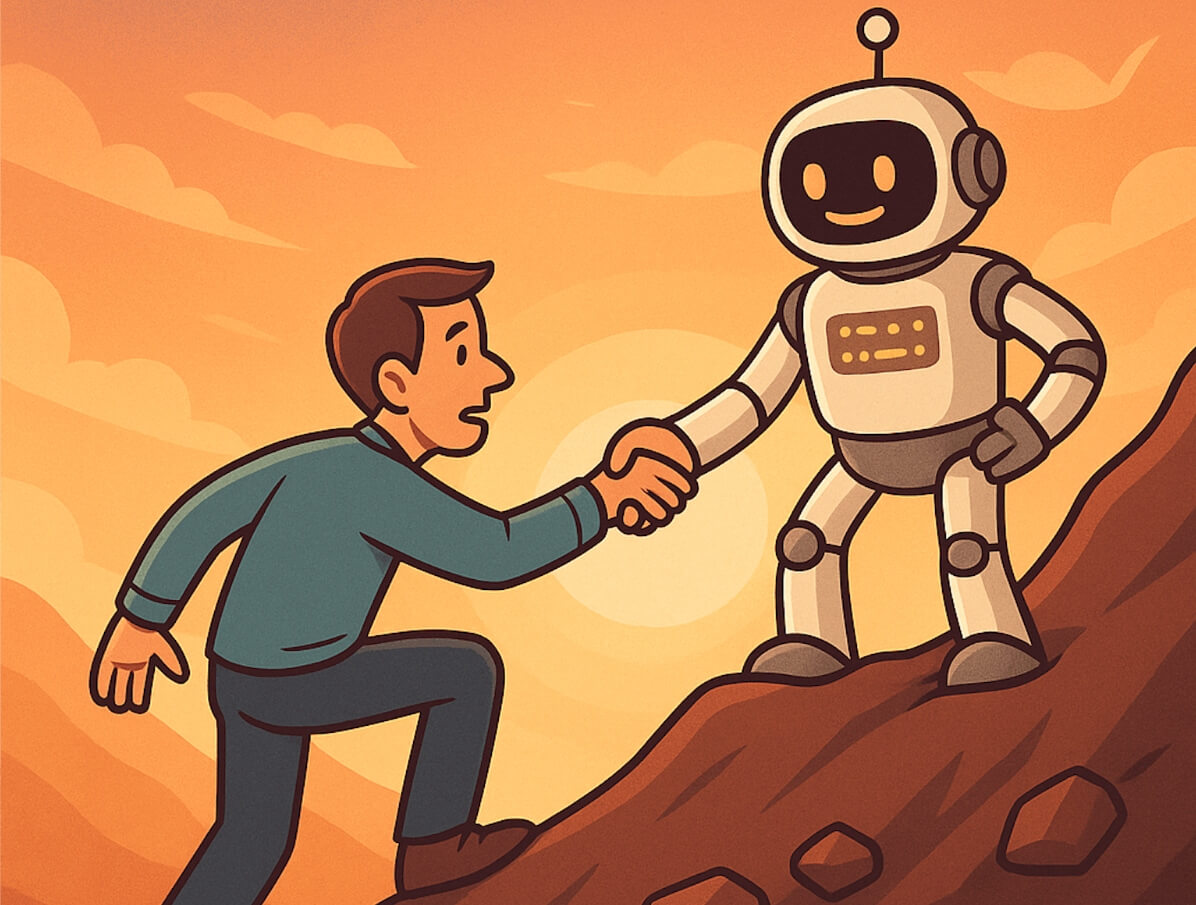
AI doesn't replace expertise. It amplifies it, but only if you're willing to learn alongside it instead of running from it.
Start small. Experiment without stakes. Build confidence before you build anything else.
That's how transformation actually happens.
What's different now
A year ago, I was staring at my laptop after getting laid off, wondering if I'd missed my chance at a meaningful career.
Today, I run a business I couldn't have imagined back then.
Not because AI handed me a business plan, but because AI gave me the tools to start moving again when standing still wasn't an option.
I don't write as much as I used to. I build more than I expected. I help teams navigate change instead of just creating content for them.
My business looks different than I thought it would. And honestly? I prefer it this way.
Why I'm telling you this
Noel Consulting Solutions exists because I've been on both sides of this shift.
I know what it's like to lead content teams under pressure. I know what it's like to lose your footing overnight. I know what it's like to feel lost and out of options. And I know what it's like to feel intimidated by AI before realizing it's not as scary as it seems.
My work now sits in that cross section. I help non-technical teams build confidence with AI; not hype, not fear, just practical skills and real tools.
If your team is ready for that next step, whether it's workshops, custom tools, or just figuring out where to start, I'd love to talk.
But more than that: if you're in the midst of your own hard season right now, I want you to know that a year from now, things can look completely different.
Not because everything magically gets easier, but because you're more capable than you think and there are so many tools out there to help you find the way forward.
The future doesn't belong to people who have it all figured out. It belongs to people willing to figure it out along the way.