We live in strange times. Our society is racing to adopt a technology it’s increasingly afraid of. Generative AI keeps working its way into more corners of our lives, and yet the more it spreads, the more pessimistic we seem to grow about where it’s taking us. We can’t quite turn away from it, and we can’t quite trust it either.
Pew Research Center recently surveyed over 5,000 U.S. adults about AI, and found that the share who use a chatbot like ChatGPT, Gemini, or Copilot jumped from 33% in 2024 to 49% in 2026 — roughly half the country, in about two years. That’s a staggering adoption curve for any technology.
Here’s the strange part. You’d expect the people using AI the most to be its biggest champions, but the opposite is true. Adults ages 18 to 29 use chatbots more than any other group, and they’re also the most skeptical of it. While 40% of all U.S. adults think AI will have a negative impact on society over the next 20 years, that figure climbs to 48% among young adults. Only 16% of Americans think the impact will be positive. Roughly two-thirds say it’s advancing too quickly.
So we have a technology half the country is using, most of the country distrusts, and the people using it most are the most worried. Why are we sprinting toward something so few of us believe will turn out well?
I don’t think this is really about the technology. I think it’s about fear, specifically a fear of irrelevance. The unspoken question underneath all the skepticism is “does what I know still matter?” Or worse: “will I still be given the chance to matter?” If AI can do so many tasks faster and better than we can, isn’t the logical conclusion that it simply replaces us? In an economy reorganizing itself around AI, are the only safe skills coding and prompt-engineering? It can feel like an Industrial Revolution on steroids, where only the most tech-savvy survive.
I want to offer a more encouraging way to see it, one where AI doesn’t make your expertise obsolete, but makes it more valuable than ever.
AI is a tool
There are two things I try to keep in mind when discussing AI.
First, it’s a tool. An extraordinarily powerful and uniquely capable one, but a tool nonetheless. And tools exist to make human work easier.
Second, like every important tool before it, AI will change how we work. There’s no denying that. Farming changed with the plow. Knowledge spread differently after the printing press. The steam engine and the automobile reshaped how goods and people moved. The telephone and the internet rewired how we connect. Each time, success came down to the same thing: figuring out how to apply the new tool to real problems in real work.
What makes AI feel different is that it’s the first tool capable of knowledge work, the kind we assumed was safe precisely because it required human intelligence and judgment. It reaches the professional class, the white-collar desk, the middle-management role that always felt like the secure bet. That’s why it feels less like an opportunity and more like a threat, like it renders hard-won experience obsolete overnight. Using it can even feel like cheating, like a shortcut around the real work of thinking.
But that’s a false choice. Using AI isn’t a measure of intelligence. It’s a tool that harnesses intelligence.
The typewriter and the laptop
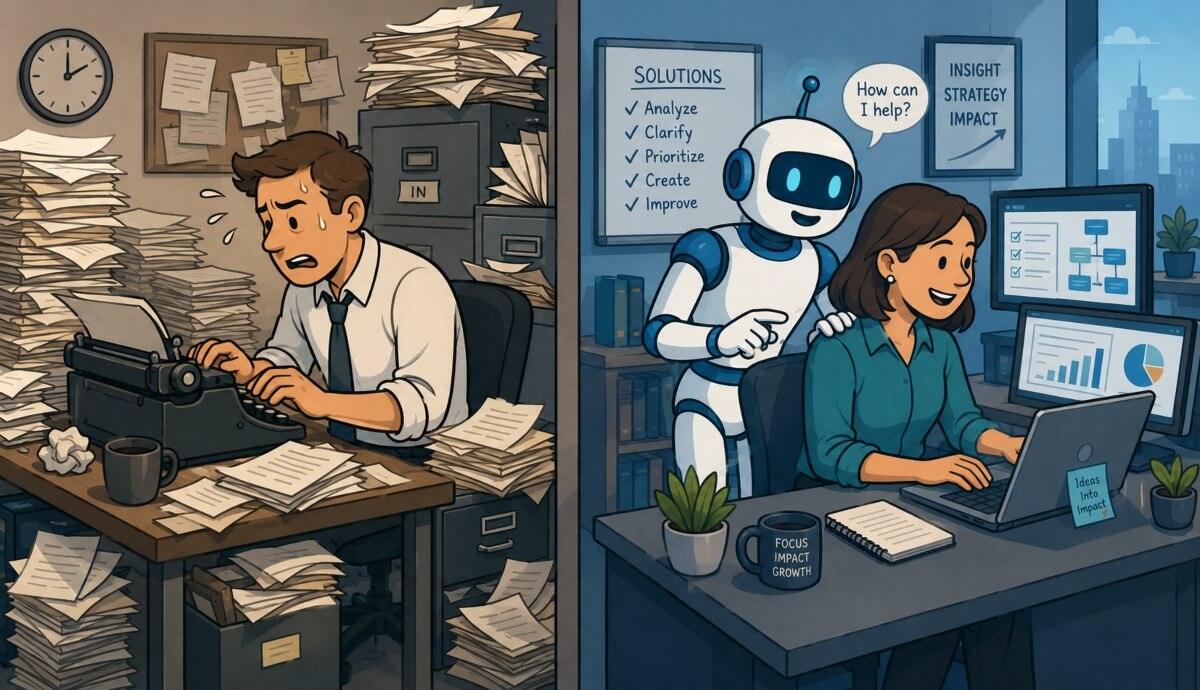
Picture two equally intelligent, equally experienced coworkers, Bob and Betty. Bob does all his work on a typewriter. Betty does all of her work on a laptop connected to WiFi. Who gets more work done? Betty will outpace Bob every time. She will be more productive, more efficient, better informed, and more adaptable. Not because she’s smarter, but because she’s using the more capable tool. The computer isn’t a substitute for Betty’s intelligence. It multiplies it.
Now flip it. Say the company offers Bob the very same laptop, but he refuses, stubbornly clinging to the typewriter. That refusal would be its own kind of self-limitation, capping what his intelligence can accomplish. But if he embraced the laptop, he’d unlock a level of output and creativity the typewriter never could. Same person, same intelligence, but one tool enabled him to do far more.
That’s how I see AI. No matter your field or how long you’ve worked in it, learning to use AI to solve the problems you already wrestle with is the real key. And here’s the difference from every tool that came before: AI can actually help you learn to use it and discover where it fits in your work. You can ask it to help you use it better.
AI’s greatest value isn’t that it replaces people. It’s that it allows human expertise to have an even greater impact.
Calculators didn’t kill accounting
There’s another historical parallel you’ll see in almost everything written about AI, and it’s worth repeating. The calculator (and later Excel spreadsheets) didn’t make accountants extinct. It pushed them up the ladder. Their work moved from grinding out arithmetic and balancing books by hand to the higher-value work of judgment, strategy, and advising real people. The technology didn’t erase the work. It transformed it, and arguably improved it.
I won’t sugarcoat the hard edges. Plenty of manual and entry-level jobs were displaced by that shift and never came back. Real people were hurt, and that’s a genuine problem we still have to reckon with as more work gets automated. But notice what happened: the calculator didn’t push accountants off the ladder. It moved them up to the more valuable, more human work in the very same field.
Expertise is the multiplier
If that sounds like wishful thinking, there’s now data behind it. Anthropic recently studied roughly 400,000 real sessions of people from different industries using Claude Code, its AI coding tool. Two findings stood out immediately.
The first: nearly every profession succeeded at technical coding tasks at close to the rate of professional software engineers. A coding background, the thing you’d assume mattered most, actually mattered far less than expected.
The second: what predicted success wasn’t technical skill, it was domain expertise. People who deeply understood the problem they were solving succeeded more than twice as often as those who didn’t. Their example in the report says it perfectly: an accountant who has never written a line of code, but who knows exactly which reconciliation rules to follow, can spot the error that breaks the month-end close better than a general programmer who lacks that industry-specific context.
Another encouraging takeaway is that the biggest gains came mostly from competence, not mastery. You don’t have to be the world’s foremost expert in your field. A solid understanding of your own work, and the context of the problems you’re solving, provides most of the benefit.
The person best positioned to thrive with AI isn’t the one who knows the most about AI. It’s the one who knows the most about their own work and is willing to pick up the tool.
How I know this works
I know this works because it’s part of my own story. It’s the path I’ve been navigating for the last two years.
I spent twelve years in content marketing, writing, editing, and leading editorial teams. It’s a field built entirely on judgment: knowing what’s clear, what’s true, what will land for your audience, what’s subtly off in a way you can’t quite name until you fix it. Then the ground shifted. A Google algorithm change pulled the rug out from under our feet and reshaped an entire industry overnight. Our websites and content disappeared from Google search results and our traffic collapsed in a matter of days. Within weeks, I was caught up in a round of layoffs.
I could have treated AI as the thing that came for my career. I could have kept trying to do things the way I had done them for 12 years. Instead, I brought what I already knew to the tool. I didn’t become a programmer. I took twelve years of editorial judgment, knowing what good user experience looks like, how to help teams solve problems, how to communicate complex ideas clearly, and used it to direct AI toward building things I could never have built alone. Today I build custom AI systems for schools and businesses using no-code tools and my own domain expertise as the steering wheel.
A year ago, I didn’t know anything about API keys or JSON. But I did know what it felt like to be a leader trying to manage information overload while still getting my own work done each day. I knew the tools I wished existed and even how I’d want them to look. I could dream up endless solutions to workplace problems. With AI, for the first time, I could actually build them.
I didn’t get pushed off the ladder. With AI, I climbed it. And the rung I climbed to only exists because I stopped treating my expertise and the tool as rivals, and started treating them as partners.
Agency over anxiety
If you’re feeling that low hum of anxiety about AI automating your job or making your expertise obsolete, I want to gently offer this new way to look at it.
The task in front of you isn’t to go back to school and become a programmer, or to out-nerd all of the AI experts. The goal is smaller and far more achievable. Just become fluent enough with these tools to recognize where they fit in your work, and then try them. Start with one problem you’re actively trying to solve and see what happens.
Your skills didn’t lose their value. They became the very thing that can power these remarkable new tools.
And if you are just starting out and worried about how to gain that experience, use AI to learn. Ask it to teach you a skill. Tell it where you want to go and let it help you map the route.
That’s the work I do at Noel Consulting Solutions. I help teams and leaders uncover the best places to connect their skills and expertise to the right AI tools. If that’s a conversation you’d like to explore, I’d love to talk about what’s possible.