One of the most important parts of being a solo consultant, I’ve learned, is getting coffee with people. And I mean a lot of coffee. I’ve now tried the dark roast at spots all across Charlotte: Caribou, Sunflower Baking, Salted Melon, Amelie’s, Night Swim, Summit. And just like the roasts, each one of these conversations is unique.
But, I’ve noticed a consistent theme in these coffee meetings. There’s a recurring moment that happens in every conversation I have with business leaders, and it doesn’t matter what industry they’re in.
I’ve seen it with a CFO at an independent school, a co-founder at a capital firm, the owner of a floral wholesale company, and leaders in construction, real estate, and manufacturing. At some point in the conversation, when I describe the AI email management system I built for one of my clients, they sit forward in their chair, raise their eyebrows, and they say some version of the same thing:
“Oh wow, I could really use something like that.”
Every single time. I’ve heard phrases like “My inbox is constantly in my way,” and “Emails are a constant distraction and disrupt my focus.”
Email overload isn’t a new insight. But the consistency of that reaction, across industries, across roles, across company sizes, tells me something important about where leaders experience friction and where AI can actually help most businesses right now. And it’s probably not where you think.
The system behind the reaction
In February, I launched a custom AI email management system for a senior leader at an independent school here in Charlotte. The problem he asked me to help solve was email volume overload. He was manually triaging urgent board inquiries buried in the same inbox as vendor newsletters, important threads competing for attention with all the noise. Inbox management had quietly become a second job eating hours of his day that should have gone to strategic work.
I designed an AI system that monitors his inbox around the clock. Every incoming email is logged, categorized, prioritized, and summarized. The AI, trained on his writing style, drafts replies in his voice. He gets three structured briefings a day, real-time alerts when a VIP sender lands in his inbox, and a live dashboard that surfaces what matters in priority order. And, importantly, it’s a human-in-the-loop system, so it never sends a message without his approval.
This week, that system crossed a cool milestone: 5,000 emails processed with a 99.7% success rate since launch. It’s also gone more than 40 consecutive days without an error. And it’s completely autonomous. No daily maintenance, no babysitting. It just runs, every day, and gives him back hours every week for the strategic work he was actually hired to do.
You can read the full story, including the architecture, the security review, and the dashboard layout, in the full case study.
It’s not about automation, it’s about triage
Here’s what that recurring lean-forward moment revealed to me.
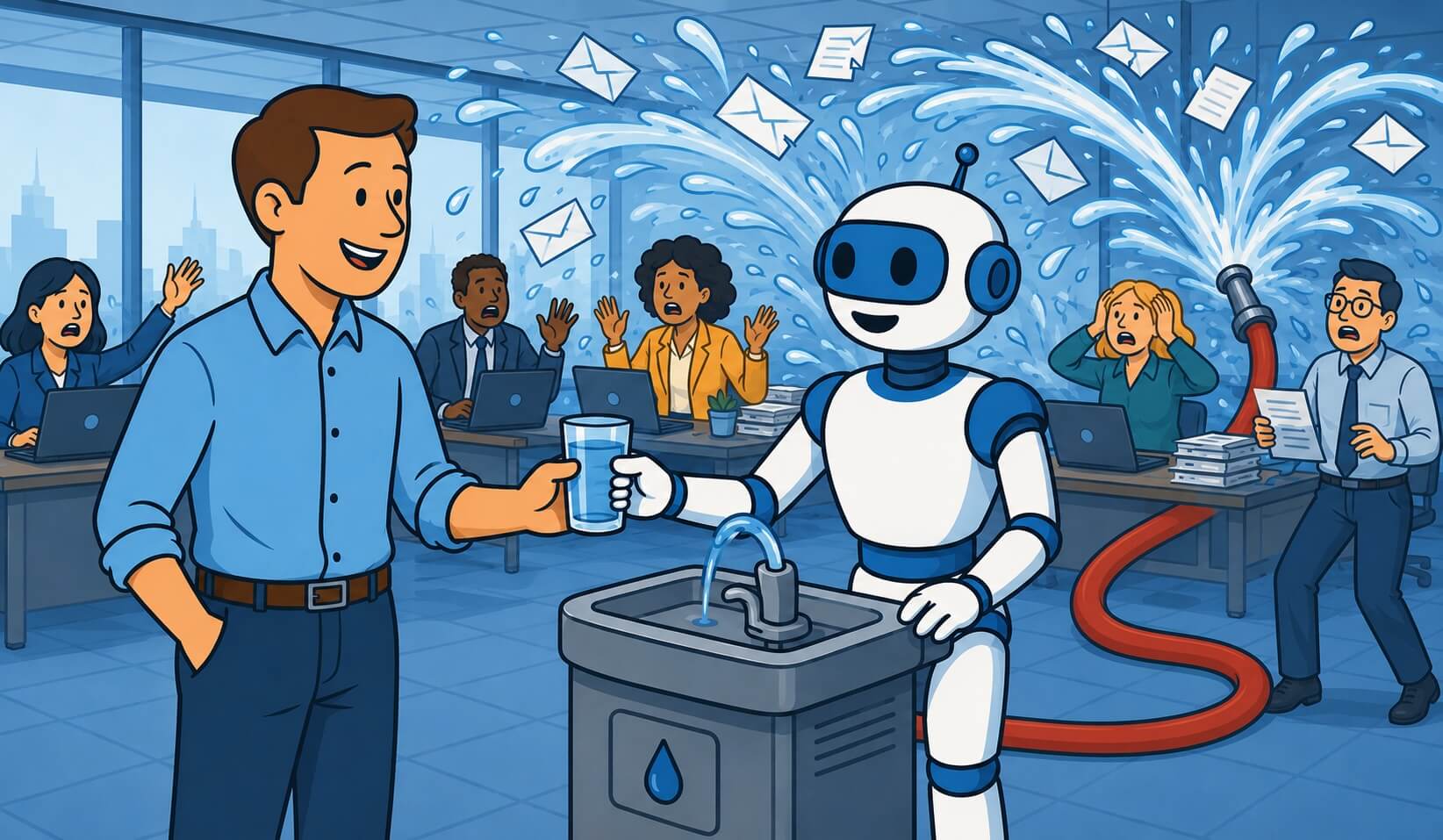
All of us, no matter what your role, operate in a world with more information to process than time to process it. Whether you run a school, a construction site, a brokerage, or a warehouse full of flowers, your day likely involves ingesting, understanding, and acting on more inputs than ever before. Emails, follow-ups, vendor updates, customer questions, internal threads, invoices. It’s a never-ending firehose of information. So we feel rushed, things get delayed, and important items slip through the cracks. Not because we’re bad at our jobs, but because the volume has outgrown the hours.
And this is exactly where most businesses get AI wrong. They hear “AI” and picture something enormous and intimidating: autonomous agents running entire workflows, custom software, a six-month IT project. It feels too complex, too advanced, too risky. "We wouldn’t even know where to begin."
But most businesses don’t need AI to automate everything. They need AI to do something much simpler and something AI is already exceptionally good at:
Process and organize the information deluge, so the right information lands in front of the right person at the right time.
That’s the unlock. Intake, categorization, summarization, prioritization, drafting. Most businesses don’t need the biggest, most expensive frontier models writing custom code. The workhorse AI models available today are already excellent at reading, sorting, and surfacing. A well-designed AI system built on top of an existing inbox can hand a decision maker back 4–5+ hours a week. The tangible ROI for most AI tools is the time it gives you back each day.
With the right AI solution, you can transform your inbox from a firehose into a drinking fountain: something you can access and control without getting soaked.
Less sifting, more deciding
In my experience, the best AI solutions for non-technical teams all share the same underlying principle: put the most important information in front of decision makers with less manual searching and scrolling. This allows them to make faster, more informed decisions and act with more confidence.
There’s another benefit, too. When AI is organizing your information stream, it can start to surface patterns you’d never catch while slogging through the work week. An AI triage system can provide the bird’s eye view to spot connections, spikes, or recurring pain points that can be hard to see inside individual messages.
That’s not science fiction. That’s the kind of system most businesses could have running in weeks, not months.
How to put AI to work for you
If you’ve been thinking of AI as something too advanced for your business, I’d offer this reframe: don’t start by asking “what could AI automate?” Start by asking “where does information pile up faster than we can process it?”
Your inbox. Your intake forms. Your customer inquiries. Your project updates. Your invoices. That’s where the hours are hiding and that’s where AI can deliver value quickly, without requiring you to overhaul how your business runs.
Because the goal isn’t to replace your judgment. It’s to help you access the information you need faster so your judgment can make a bigger impact. It’s to help you drink from the information stream instead of drowning in it.
Want to see what this looks like in practice? Read the full case study on the AI email management system. 5,000+ emails and counting.
And if you’re spending hours a week on inbox triage instead of the work you need to do, let’s grab coffee. I’m always looking to try new dark roasts.